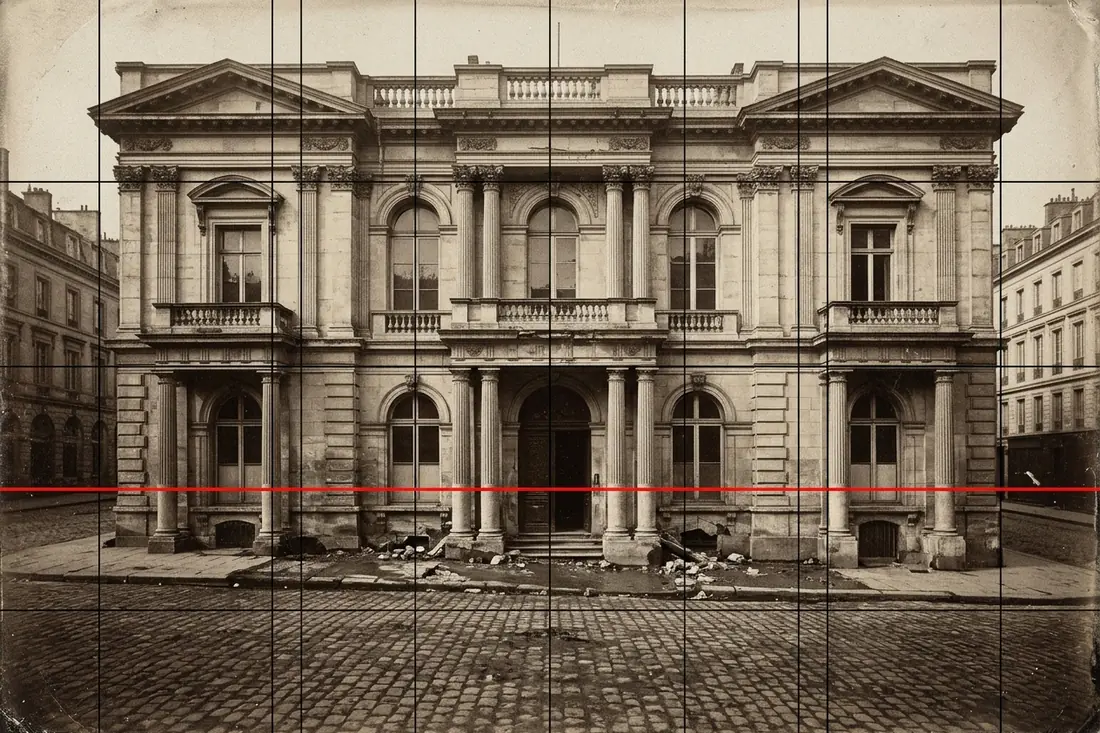
The basement becomes a buried civilization
The mudflood interpretation treats below-street doors and windows as evidence that a sudden deposit covered an earlier city. The surviving architecture is real; the inference is that the ground rose through catastrophe rather than a recorded change in street grade. Similar-looking entrances elsewhere are then assembled into a single worldwide event.
A particular building can settle, be remodelled or be surrounded by later fill. To decide which occurred in Chicago, the relevant comparison is between its physical levels and the city’s grading work. A photograph of a low doorway identifies a difference in height. It does not identify the material, date or cause of that difference.
The lifting operation was public
Chicago’s street raising was connected to drainage and the installation of sewers. Some owners raised their buildings; others left them at the previous level. That creates precisely the uneven streetscape that looks anomalous when the construction history is removed.
A contemporary account describes the Lake Street operation between Clark and LaSalle: 6,000 screws worked by 600 men raised the block four feet eight inches in five days. Permanent supports were then built underneath. The report describes occupied commercial premises, with access maintained during the work. This was a visible urban construction job.
The scale is difficult to picture because the verb “lift” suggests one dramatic movement. A screw jack instead trades a long rotational motion for a small vertical motion. Spread the supports across the structure and keep the movements coordinated, and the whole building can rise through repeated short increments.
Count turns instead of imagining one enormous shove
The recorded rise is 56 inches. For the opening example, assume each full revolution of a screw raises its support by a quarter inch. That screw needs 224 full revolutions to complete the lift. Dividing the recorded screws among the recorded operators gives an average of ten screws per person.
Each operator therefore has 2,240 full-revolution equivalents across the five-day lift. With an assumed ten active hours each day, the average workload is 44.8 revolutions an hour, about one every 80 seconds. Moving each screw through a quarter revolution at a time would raise it only about 1.59 millimetres under the chosen screw geometry.
The tool calculates movement, not the force needed at the handle. Friction, lever length, support loading and temporary foundations determine that separate problem. The selected screw rise and working hours are assumptions; they are not measurements recovered from the crew’s schedule. Increasing the rise per revolution reduces the required turns, while longer working hours spread those turns over more time.
Turn the screws under the Lake Street block
Use the recorded lift, workforce and five-day interval. Choose the screw rise and active hours to see the required average motion; this does not calculate jack capacity or handle force.
An equal share of the recorded screws over the entire lifting interval.
Time budget under the selected daily working hours, including movement between screws.
Small coordinated increments can accumulate into the reported 56-inch lift.
Working tape
- Average screws per operator
6,000 ÷ 600 = 10 - Full turns needed by each screw
56 ÷ 0.25 = 224 - Full-turn equivalents per operator
224 × 10 = 2,240 - Selected active hours across the lift
5 × 10 = 50 - Full-turn equivalents per operator-hour
2,240 ÷ 50 = 44.8 - Average seconds per full-turn equivalent
3,600 ÷ 44.8 = 80.357143 - Rise for a quarter revolution
0.25 × 0.25 × 25.4 = 1.5875
A difference in floor levels has a construction record
The calculated workload makes the motion legible. The documented operation was distributed across thousands of support points and hundreds of operators, with a large final rise assembled from small changes. Keeping those support points coordinated was a central engineering task. The numbers do not describe people casually holding up a building.
Chicago’s low entrances do not require a missing catastrophe to explain them. The public record supplies a changed street grade, the means to raise buildings that joined it, and the reason other buildings remained lower. In this case the extraordinary account is also the documented one: sections of the city were deliberately lifted, and their foundations were completed beneath them.
What Tartaria means
Tartary, or Great Tartary, was a name European mapmakers used from the Middle Ages to the nineteenth century for the large, poorly known region of northern and central Asia. Maps with the label are genuine, and so are maps labelled Moscow Tartary or Chinese Tartary. The Tartaria theory takes the label as the name of a single advanced empire whose buildings were erased by a global mud flood. Nothing in the maps says a unified state existed; they record a European habit of naming a region by its peoples.
The architectural half of the claim rests on grand nineteenth-century buildings and on world’s fairs. The 1893 World’s Columbian Exposition in Chicago built its ‘White City’ from staff, a plaster and fibre mixture on wooden frames, and most of it was torn down or burned within a year or two. Temporary buildings that vanished are not evidence of an erased civilization.
Why people believe it
Below-street doors and windows exist in many old cities, and photographs of them are easy to share without dates. Chicago’s case is documented: engineers raised the grade of the downtown streets in the 1850s and 1860s to install a sewer system, and entire brick buildings were jacked up on screws while business continued. The calculator gives the workload of that engineering rather than a catastrophe, in turns of a screw per person.