A minute for an entire block
The claim is that the pyramid could not have been quarried, transported and assembled by ancient workers. The numerical version divides the stone count by an assumed construction period, then treats the short interval between completions as the entire time available to make each block. An advanced lost technology, or an outside builder, supplies the missing capacity.
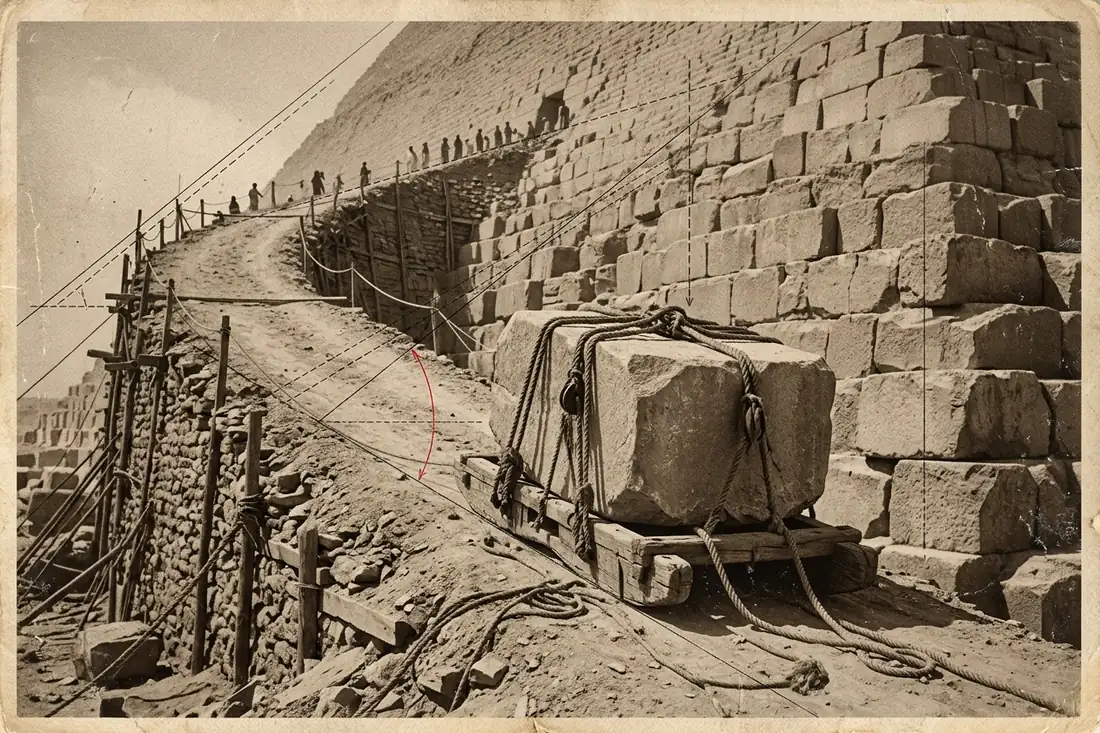
That arithmetic begins with a real difficulty. Even an average-sized block needed handling, and exceptional stones demanded exceptional arrangements. A successful account must accommodate supply, access, positioning and interruptions. Simply saying that there were many workers does not establish that they could all reach the same place.
The construction site extended beyond the monument
The estimated count used here is 2.3 million blocks, a working quantity also used in published construction research. It is not a stone-by-stone inventory of the interior. The masonry contains different sizes and arrangements, so an average rate describes the whole undertaking without making every delivery identical.
Excavators at Heit el-Ghurab found the supporting city: workshops, kitchens, stores and administrative buildings. Its connection is clearest for the projects of Khafre and Menkaure, with a probable connection to Khufu. The distinction matters. Evidence for Giza’s construction organization is extensive, while individual facilities cannot automatically be assigned to one pyramid.
Khufu has a more direct logistics record. The papyri recovered at Wadi el-Jarf include the journal of Merer, whose team carried limestone from Tura to the Great Pyramid’s building site. Builders’ marks are also being recorded on the monument. These are traces of organized work, not a surviving instruction manual for every lifting operation.
Separate the site clock from the crew clock
The opening schedule assumes 20 years, 300 working days a year and 10 productive hours a day. That gives 60,000 site hours. Completing 2.3 million blocks in that window requires about 38.3 completions an hour, or one every 1.57 minutes somewhere on the project. None of those calendar choices is presented as an excavated timesheet.
Now assume 20 independent placement teams share the output equally. Each team must complete a block about every 31.3 minutes on average. Quarriers and transport crews would also need to keep those teams supplied. This is a completion interval for a proposed arrangement, not a measurement of how long cutting or hauling a stone took.
The controls expose the trade. Halving the working days doubles the required hourly output. Doubling independent teams doubles the average interval available to each one. Confining placement to one team recovers the alarming short interval. Whether a particular ramp and course geometry can sustain the selected number of teams is the next engineering question.
Set the pyramid’s construction schedule
Keep the estimated block count fixed and choose a work calendar. Independent teams must each have access and a continuing stone supply; their number is an assumption to test.
All placement teams together must sustain this average.
Each independently supplied team must finish one placement this often.
This output is required on the selected productive days.
Working tape
- Total productive days
20 × 300 = 6,000 - Total productive site hours
6,000 × 10 = 60,000 - Required site completions each hour
2,300,000 ÷ 60,000 = 38.333333 - Minutes between site completions
60 ÷ 38.333333 = 1.565217 - Minutes between each team’s completions
1.565217 × 20 = 31.304348 - Required blocks each productive day
2,300,000 ÷ 6,000 = 383.333333
A throughput target is not an extraterrestrial signature
The count creates a demanding logistics target. It does not establish an impossibility by itself, because the interval between finished blocks is not the processing time of a block. A proposal fails if its access routes or supply system cannot meet the calculated output; the remedy is to examine those constraints explicitly.
The archaeological record already contains the human organization and a contemporary stone-transport operation. The unresolved details concern how that organization executed particular tasks. At the opening settings, the pyramid asks for roughly 38 completed placements per hour across the site. It does not ask one worker to quarry, sail and install a block in 94 seconds.
Why people believe it
The scale is hard to hold in the mind. The Great Pyramid was built for the pharaoh Khufu in the Fourth Dynasty, around 2600 BCE, and contains on the order of 2.3 million blocks. A single number invites the thought that no ancient society could have organised it, and ancient astronaut books made that thought popular. The workers left evidence, though. In 2013 Pierre Tallet’s team found papyri at Wadi al-Jarf on the Red Sea that include the logbook of an official named Merer, who recorded a crew moving limestone by boat to Giza during Khufu’s reign. The workers’ town and bakeries near the site were excavated by Mark Lehner’s team.
Where to test it
The throughput calculation is the same division you would use for any large project: total units, working days, hours per day, independent teams. Change the crew count and the working day to see what rate each setting implies.