The fragments were offered as one evolutionary story
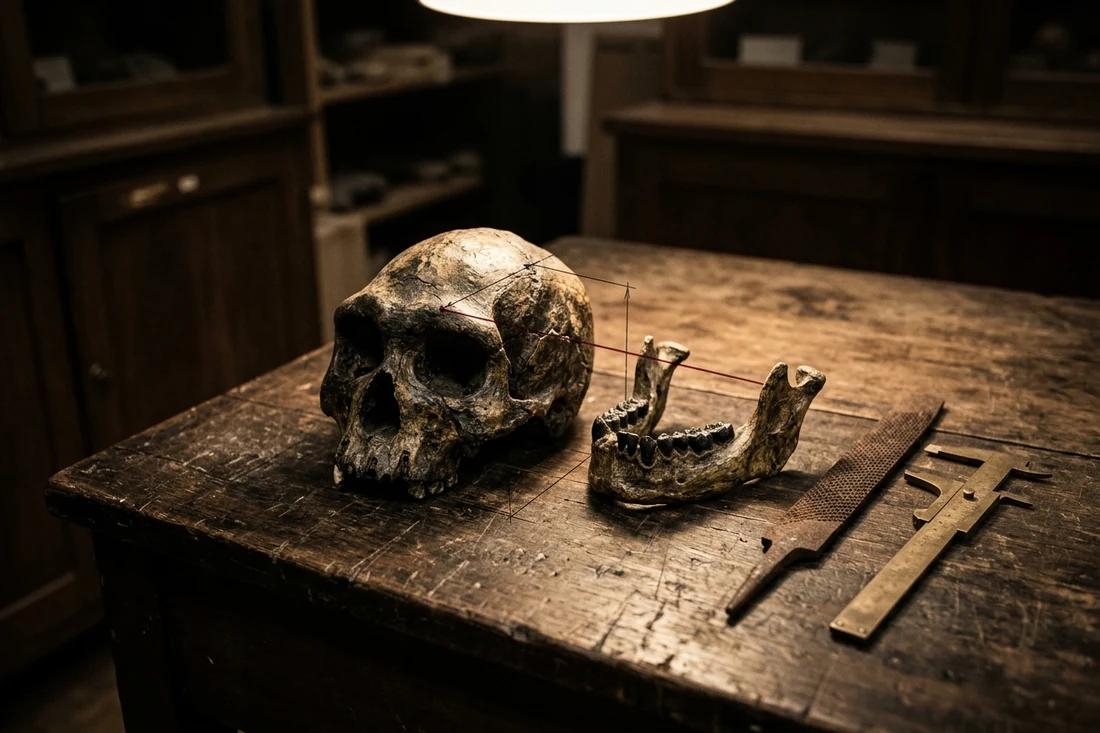
The original claim was that the cranial fragments and jaw belonged together as evidence of an early human form. A large braincase with a more ape-like jaw supplied an apparently useful intermediate combination. Once fragments have been presented under one specimen name, however, a single label can conceal several separate propositions: common place, common age, common individual and common species. Each requires evidence of its own.
The object preserves the assembly work
The physical finding is direct. Piltdown combined human cranial material with orangutan remains. Teeth were altered, and the assemblage was stained. Later imaging exposed gravel and filling material used in its preparation. The apparent biological transition had been assembled from parts; the manufacturing traces survive in those parts.
The 2016 study also reviewed attempts to date the material. It reported a determination of 620 ± 100 radiocarbon years for a Piltdown I parietal fragment and 970 ± 140 for a Piltdown II frontal fragment. One question was whether those cranial pieces could have come from the same individual.
The researchers attempted further dating, but chemical pretesting, contamination and lack of suitable material prevented a reliable resolution. The earlier numbers consequently cannot be promoted into settled calendar ages. That chemical problem is separate from the evidence that the assemblage was manufactured.
What do the quoted errors permit on their own?
The instrument examines the nominal numerical comparison: how far apart are the published central values relative to their reported errors? Subtracting gives 350 radiocarbon years. For independent errors, combine the quoted standard uncertainties by squaring each, adding the squares and taking the square root. The result is about 172 radiocarbon years.
The difference is therefore about 2.03 combined standard uncertainties. That number describes the tension between the two determinations under the selected independent-error assumption. It is not a probability that the bones belonged to different people. It also does not include unknown offsets from chemical contamination.
Double both quoted uncertainties while retaining the same central values and the standardized difference halves. Move the central values together and the standardized difference also falls. Those controls show why two dates cannot be compared simply by placing their printed years beside one another. An age estimate contains a spread as well as a centre.
There is another distinction in the paper’s observation that the separate intervals overlap only when expanded to twice their quoted errors. Overlapping individual intervals and the uncertainty of a difference are different calculations. Neither supplies proof of one donor. Even genuinely identical ages would establish contemporaneity, not personal identity; several people can live during the same period.
Compare the published cranial determinations
Opening values are reported historical radiocarbon determinations. Their quoted errors are combined as independent standard uncertainties; contamination offsets are not supplied by those error bars.
Nominal agreement of the two quoted determinations; not a probability of different donors.
The difference before accounting for either quoted uncertainty.
Combines the supplied errors assuming independence; no extra contamination offset is included.
Working tape
- Difference between central values
970 − 620 = 350 - Magnitude of the date difference
abs(350) = 350 - First squared quoted uncertainty
100 ^ 2 = 10,000 - Second squared quoted uncertainty
140 ^ 2 = 19,600 - Sum of independent variances
10,000 + 19,600 = 29,600 - Combined standard uncertainty
√(29,600) = 172.046505 - Difference in combined-error units
350 ÷ 172.046505 = 2.034334
The fabrication is clearer than the donor chronology
The reported central values differ by 350 radiocarbon years, against roughly 172 years of combined quoted uncertainty: about 2.03 combined-error units. Chemical contamination prevents those nominal determinations from assigning secure ages to the fragments. Enlarging their printed error bars alone would not identify or remove that contamination.
Modified teeth, mismatched biological material and preparation traces establish the assembly. Piltdown demonstrates a useful asymmetry: a manufactured object can be identified while the exact chronology of its ingredients remains unresolved. The object is a documented forgery; its donor history is a further investigation.
Why people believe it, and why it matters
The fragments were presented in 1912 by Charles Dawson as the missing link, and for forty years the specimen shaped British ideas about human origins, partly because it matched what scientists expected: a large brain in an ape-like skull. In 1953 Joseph Weiner, Kenneth Oakley and Wilfrid Le Gros Clark showed with fluorine tests and microscopy that the jaw belonged to an orangutan, stained and filed to look old. The case belongs in a list of hoaxes because it is a real forgery that science itself detected. The method that unmasked it, comparing independent measurements, is the one used on every page here.
Where to test it
The calculator expresses the two dates’ disagreement in units of their combined uncertainty. When the gap is many times the uncertainty the two pieces cannot come from one individual of one age; change the quoted errors to see how large an error would be needed to hide it.