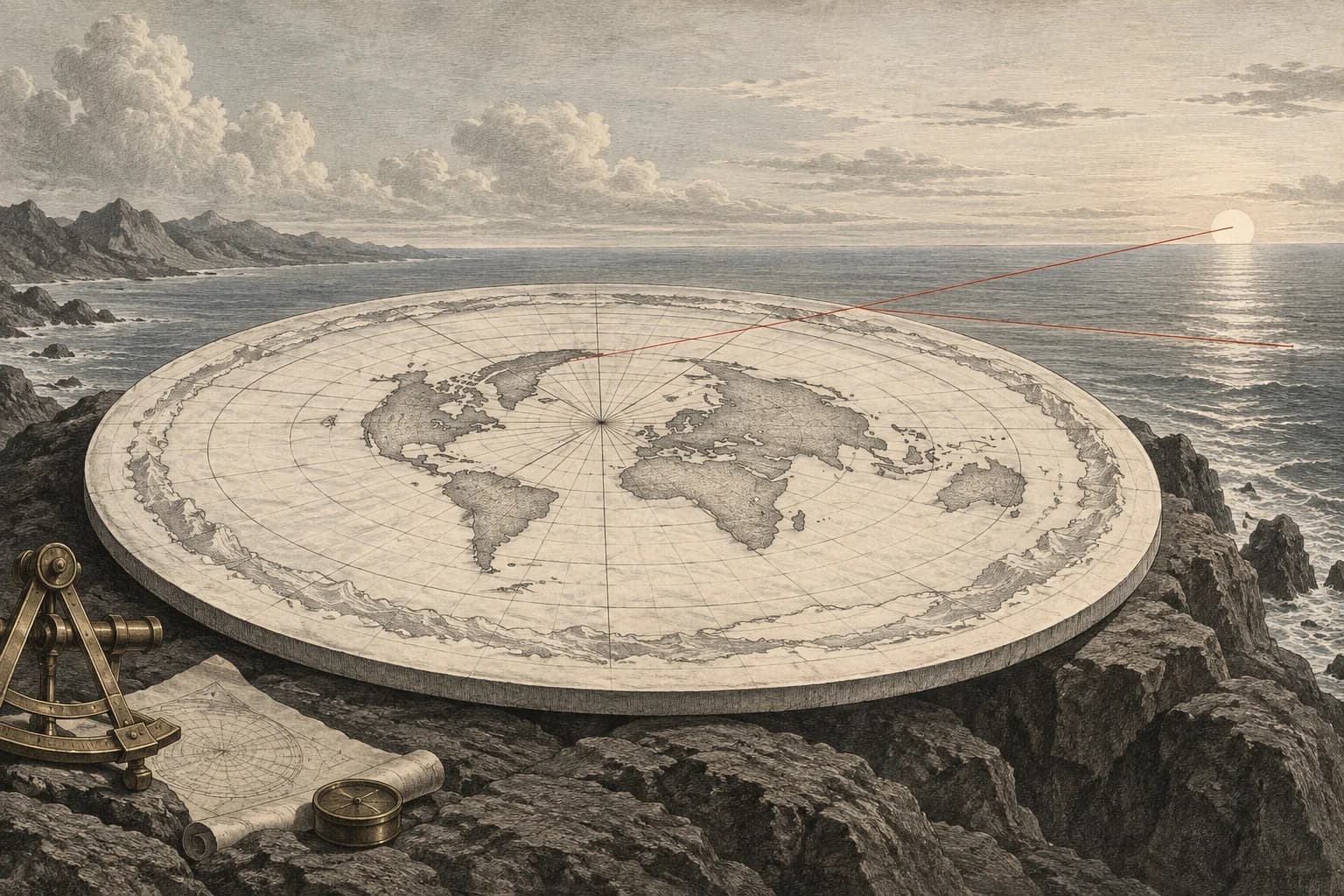
One pair of shadows, two possible stories
Different shadow angles can be described by a curved surface under nearly parallel sunlight, or by a nearby light over a plane. A pair of sticks alone does not settle every model: the distance to the light and additional locations matter. The calculation here asks what circumference follows from the parallel-ray spherical model.
The separation must match the measured angle
Eratosthenes used the difference in the Sun’s direction between two locations to estimate Earth’s circumference. The geometric idea survives without choosing a disputed modern length for the ancient stadion.
For a repeatable experiment, choose locations near one meridian, make the sticks vertical and measure at local solar noon on the same date. Civil noon is not necessarily solar noon. Use the north–south surface distance, not a road journey or a diagonal distance between arbitrary cities.
The inputs below are an illustrative 800 km and 7.2°, not a claimed reconstruction of the original survey. The angle is the difference between the two solar zenith angles; observations on opposite sides of the subsolar point require the signed angles rather than subtracting two unsigned lengths.
Scale the measured arc to a complete circle
If an arc of length s subtends angle θ, it occupies θ/360 of the complete circumference. Therefore C = 360s/θ. Holding the angle fixed, doubling the measured distance doubles C; holding distance fixed, doubling the angle halves it.
The relative angle-error control applies an interval around the entered angle while holding distance fixed. A larger angle gives the lower circumference and a smaller angle gives the upper one. These are sensitivity bounds, not a statistical confidence interval and not a correction for an incorrectly measured baseline.
Turn two shadow angles into a circumference
Enter the north–south baseline and the positive difference in solar zenith angles. The rays are parallel and the surface is spherical.
The circumference implied by the entered arc and angle.
The larger angle produces the smaller circumference.
The smaller angle produces the larger circumference.
Working tape
- Baseline × full-circle angle
800 × 360 = 288,000 - Scale the observed arc to 360°
288,000 ÷ 7.2 = 40,000 - Convert angle error to a fraction
2 ÷ 100 = 0.02 - Larger-angle factor
1 + 0.02 = 1.02 - Smaller-angle factor
1 − 0.02 = 0.98 - Circumference at the larger angle
40,000 ÷ 1.02 = 39,215.686275 - Circumference at the smaller angle
40,000 ÷ 0.98 = 40,816.326531
A short baseline reaches around the planet
The opening 7.2° angle is one fiftieth of a circle. Fifty copies of an 800 km arc therefore make 40,000 km. A 2% angular interval changes that result asymmetrically: division by a smaller angle increases the answer more than division by the equally larger angle reduces it.
Repeat the measurement with a different baseline and compare the inferred circumference. Agreement across more than two sites tests a model more strongly than choosing a lamp height that fits only one pair of shadows.