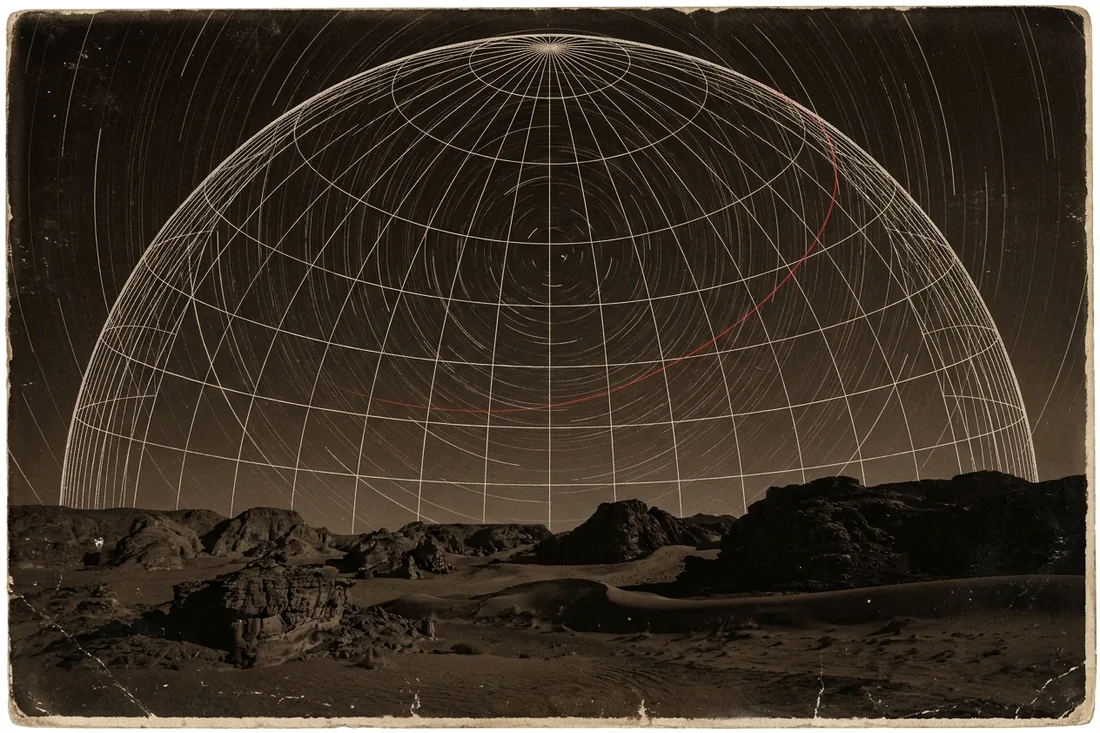
The claim: the sky is a solid dome over a flat Earth
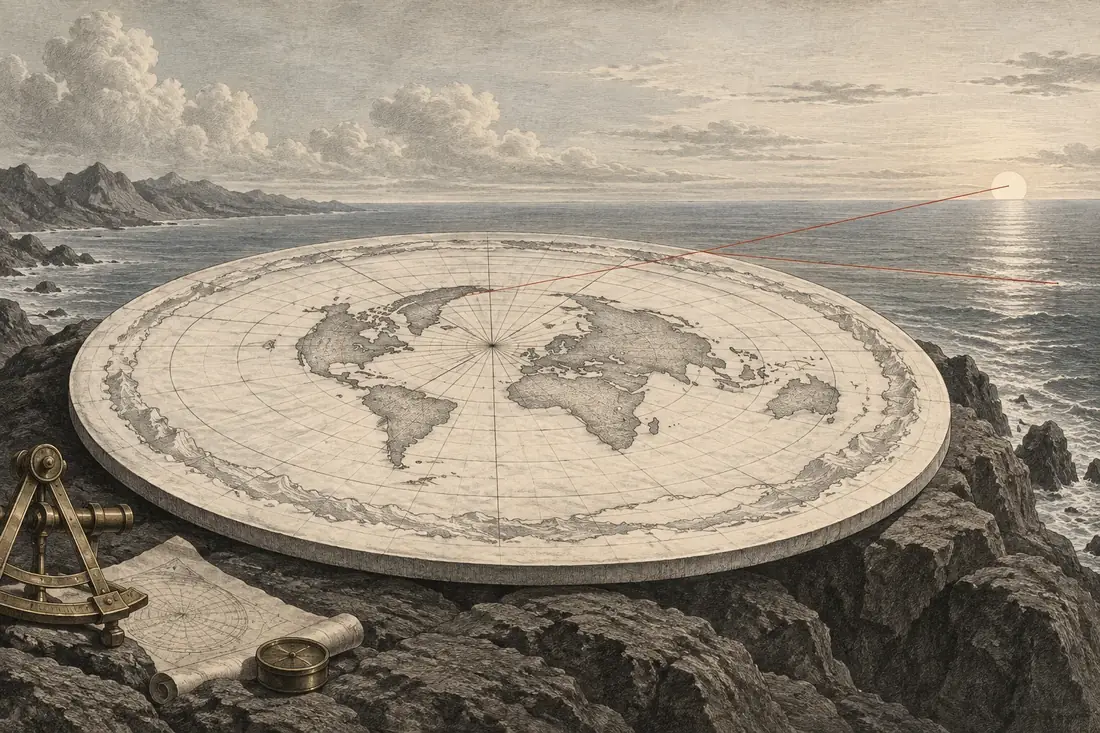
In flat earth cosmology the firmament is a solid dome over the Earth’s disc that holds back the waters above and carries the Sun, Moon and stars. It is usually tied to the opening chapter of Genesis, and its height is stated differently by different authors, from a few thousand kilometres to much less.
The claim joins two questions that are worth separating: what an ancient text meant by its word, and whether anything of that kind is found when the sky is explored.
The word and what observation found
The English word comes from the Latin firmamentum, used in Jerome’s Vulgate translation around 400 CE. Jerome was translating the Greek stereoma of the Septuagint, a version made in the third and second centuries BCE, which in turn rendered the Hebrew raqia of Genesis 1. Raqia comes from a root meaning to beat out or spread, the verb used for hammering metal into a thin sheet. The King James Version of 1611 carried ‘firmament’ into English.
Scholars of the ancient Near East, such as Paul Seely in a 1991 article in the Westminster Theological Journal, have argued that Hebrew, Mesopotamian and Egyptian writers described a solid vault, and that translators later softened it into an expanse. Whether the writers meant a literal solid is a question about what they believed. It is a different question from what is above us.
Observation has covered the heights where a dome would sit. Balloons reached the stratosphere in the 1930s. In 1957 the Soviet Union launched Sputnik 1, which orbited at several hundred kilometres. Yuri Gagarin orbited the Earth on 12 April 1961. In December 1968 Apollo 8 carried three astronauts around the Moon, and Apollo 13 in April 1970 took a crew to a record 400,171 km from Earth. Radio signals, tracking and independent observers in several countries followed each flight.
Counting what has been passed through
The calculator divides the Apollo 13 record distance by the dome height you choose. At 1,000 km, the farthest crewed flight went 400 times higher. Raise the height to 100,000 km and the ratio is still above four. The only dome height the record allows is one beyond the distance of the Moon.
The second output is the time to rise straight up to the dome at an airliner’s speed. A journey to 1,000 km at 900 km/h takes about an hour and seven minutes of climbing, which makes the point that the height of any claimed nearby dome is not beyond reach.
How many times has a crewed flight passed the dome?
Choose a height for the firmament and the speed of a vertical climb. The farthest crewed distance is the Apollo 13 record of 400,171 km.
How many dome heights the farthest crewed flight covered.
Hours at constant speed, ignoring air thinning and fuel.
Working tape
- Times beyond the dome
400,171 ÷ 1,000 = 400.171 - Hours to climb to the dome
1,000 ÷ 900 = 1.111111 - Minutes
1.111111 × 60 = 66.666667
Nothing solid was found where a dome would be
Crewed flights, uncrewed probes and satellites have passed through every altitude at which a dome of the heights proposed would stand, without striking a barrier. Satellites in orbit below 2,000 km, geostationary satellites at 35,786 km and lunar missions travel through the same space on paths that agree with ordinary orbital mechanics.
The word firmament continues to mean the sky in literature and language, and the interpretation of an ancient word is for scholars of the text. As a physical claim about a solid vault above the atmosphere, it fails the test that its supporters set themselves: that a measurement should decide.
Why people believe it
The sky does look like a dome, because the ground and the horizon make a bowl of our view. Stars seem fixed on a surface that turns overnight, and the Sun and Moon seem to be the same small distance away. Ancient texts that describe a vault read naturally to those who take them literally. For people who accept those texts as authority, the burden is on the measurement to explain why the text should be reread. A visible dome is the default impression, and every contrary fact (distances to stars, orbits, parallax) requires a chain of reasoning and trust in institutions that not everyone shares.
Where to test it
The star-trail rotation that appears to carry the sky overhead has a simple explanation in Earth’s rotation, which the star trails tool and the Foucault pendulum show. The apparent size and distance of the Sun is a shadow measurement, found in the Eratosthenes experiment.