Excavation was offered as proof of antiquity
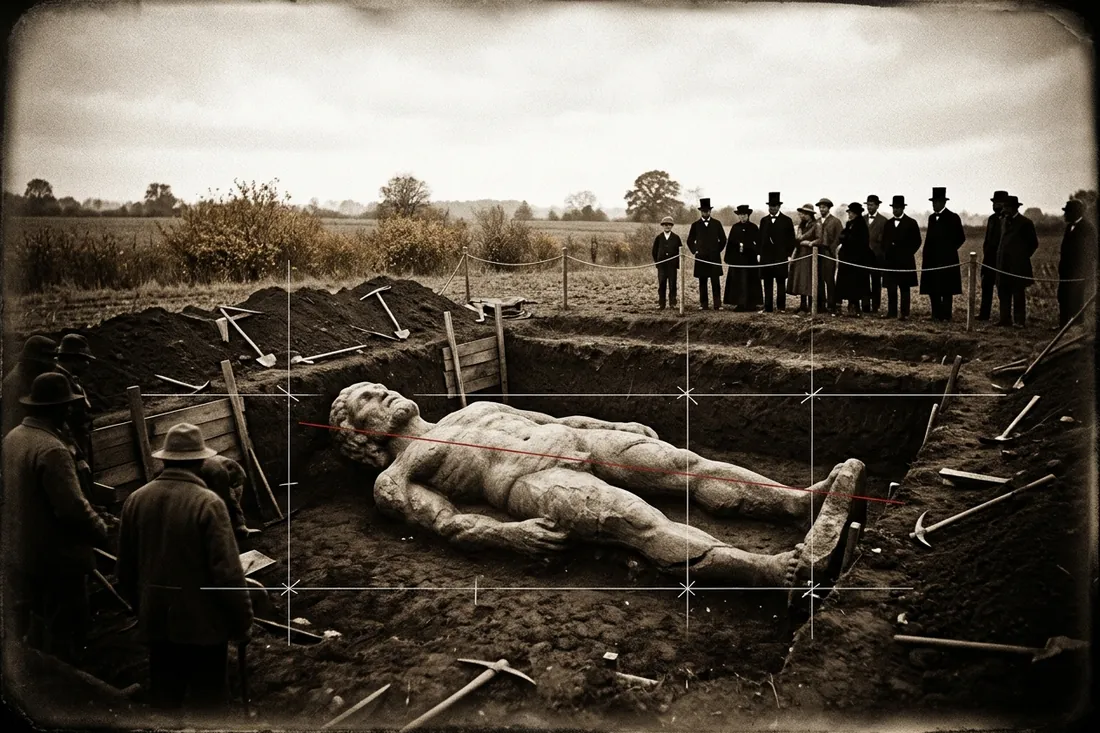
The claim presented the excavated human-shaped figure as a petrified giant. The discovery setting carried much of the argument: a large object emerged from the earth, apparently too substantial to dismiss as a rumour or an invented drawing. But being underground establishes only where an object was found. It does not establish when it entered the soil or whether its shape was carved before burial.
The museum holds the manufactured evidence
Fenimore Farm’s account identifies George Hull’s scheme, the carving of a five-ton gypsum block, shipment to Cardiff and burial followed by unearthing. The final object is the surviving product of that operation. The museum acquired it in 1947 and preserves it as a historical fabrication.
Its mass is also documented by a later participant in its movement. Bruce Museum curator Daniel Ksepka described arranging the sculpture’s loan for an exhibition and moving the 2,990-pound object with a hoist onto a reinforced wheeled platform. This is a useful physical fact: the giant remained an awkward freight item long after anyone needed it to be a petrified person.
The initial block was heavier still. Carving a figure cannot conserve all the material in a rectangular blank. Space around the head, limbs and torso becomes chips and offcuts. A reconstruction of the fabrication should therefore account for both the statue that travelled and the stone that never left the workshop in that form.
Follow the missing gypsum
The instrument performs that mass balance. Its opening block mass is 10,000 pounds, an explicit interpretation of the museum’s approximate five-ton description using U.S. short tons. The account does not specify a ton convention. Entering a different starting mass changes the result without changing the sculpture’s documented 2,990 pounds.
Subtracting the finished figure from the selected blank gives 7,010 pounds of removed material. About 70.1 percent of the opening block is absent from the final sculpture. The waste weighs about 2.34 times as much as the object that became the attraction. These figures are conditional on that starting-mass interpretation, rather than a recovered workshop weighing book.
The second control gives the mass assigned to one hypothetical waste load. At 200 pounds per load, the removed material represents 35.05 load-equivalents. A fractional equivalent expresses total mass divided by the selected load; it does not assert that a historical cart carried that amount or that 35 trips completed the job.
Raise the starting mass and the waste increases pound for pound. Increase only the assumed load size and the number of equivalents falls, while the total removed material stays unchanged. That distinction matters: choosing larger transport equipment can change the handling schedule, but cannot make the workshop’s material balance disappear.
Account for the gypsum removed
The 2,990-pound finished mass is documented. The opening 10,000-pound block interprets the museum’s approximate five tons as U.S. short tons; adjust that assumption.
Mass balance under the chosen starting block assumption.
The selected blank’s mass that is absent from the surviving sculpture.
Total removed mass expressed in loads of the selected size, not a count of documented trips.
Working tape
- Block mass minus finished sculpture
10,000 − 2,990 = 7,010 - Share of block removed
7,010 ÷ 10,000 = 0.701 - Percentage removed
0.701 × 100 = 70.1 - Waste compared with sculpture
7,010 ÷ 2,990 = 2.344482 - Removed mass divided by selected load
7,010 ÷ 200 = 35.05
The object travelled; most of its original block did not
With the selected five-short-ton starting block, carving removes 7,010 pounds of gypsum: 70.1 percent of the blank. The removed material weighs about 2.34 times as much as the surviving sculpture. At the assumed 200 pounds per waste load, that is 35.05 load-equivalents of material outside the finished attraction.
The giant’s emergence from the soil was real, as was the work needed to put it there. Its false history was attached after quarrying, carving, transport and burial had already produced a convincing object. The discovery had a backstage; the missing gypsum belonged to it.
Why people believe it, and who made it
The figure was dug up on 16 October 1869 on William Newell’s farm at Cardiff, New York, where it had been buried a year earlier. Its maker was George Hull, a tobacconist, who commissioned a block of gypsum from Fort Dodge, Iowa, had it carved in Chicago and shipped to the farm. Crowds paid to see it, and some clergy and geologists were taken in, while others called it a fake from the start. Hull admitted the hoax in December 1869, and P. T. Barnum had a copy made when he could not buy the original. The case shows how little an excavation proves about an object’s age.
Where to test it
The mass balance turns the rough dimensions of a figure into the amount of rock removed. The carving left roughly this much waste, which the workshop’s trail of receipts and shipping records shows. Change the starting block to see how much of it a human figure uses.