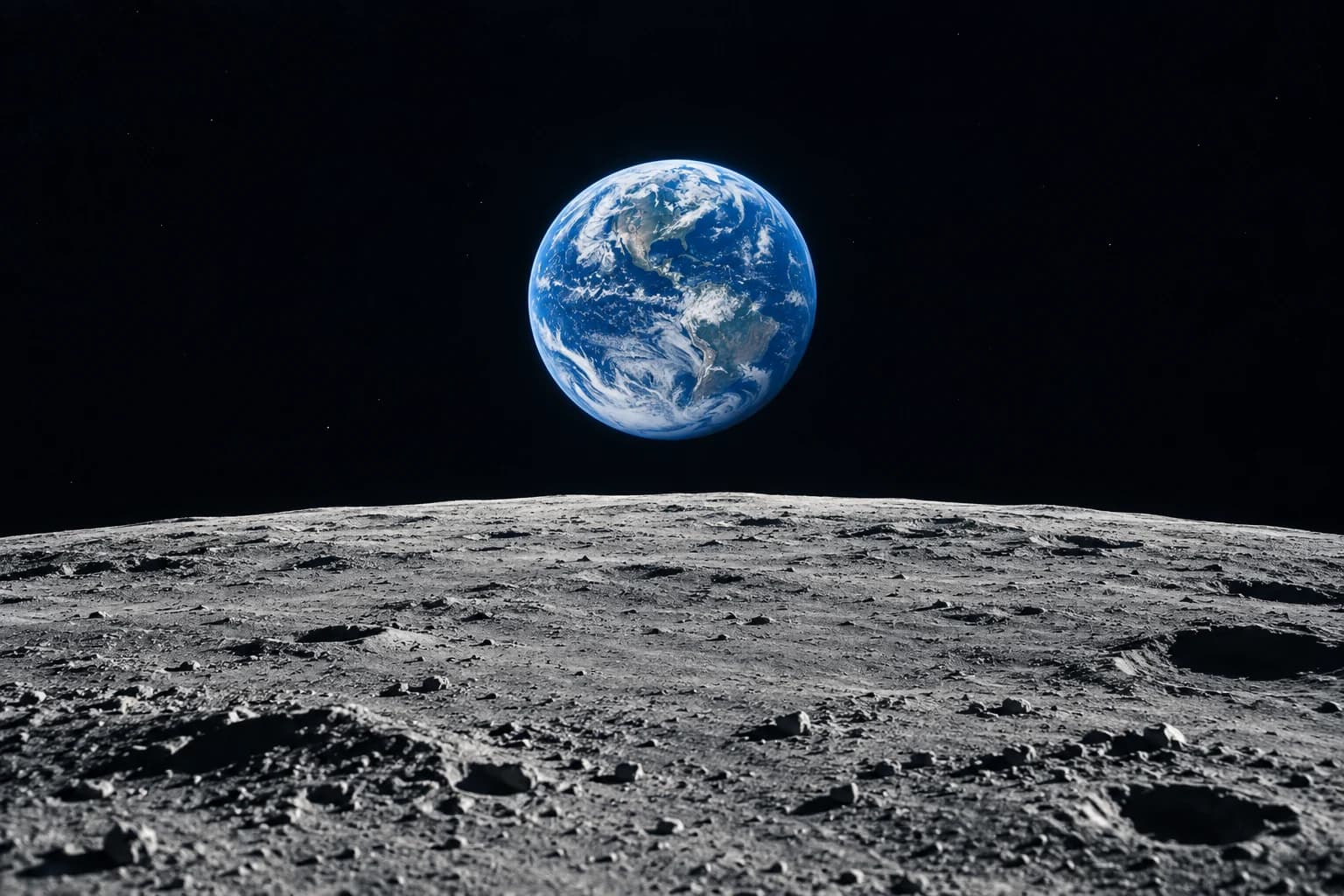
An empty sky becomes a missing location
The claim is that a genuine lunar photograph should contain stars, so their absence reveals a dark studio backdrop. The reasoning starts with a reasonable observation: space contains stars and the lunar sky in the photograph looks black. The unsupported step is treating the photograph as a complete record of everything luminous in that direction.
A camera records the light collected during a particular exposure. A black region can mean that too little light registered there, even while something bright occupied the same direction. The relevant question is therefore not whether stars existed above the astronaut. It is whether the chosen exposure would have recorded them beside the illuminated foreground.
The surface settings were deliberately short
Apollo 11’s mission report describes a practical constraint that preceded the photographs. A suited astronaut could move the camera during a slow exposure. The adopted nominal shutter time was 1/250 second. Apertures were then selected for the expected lunar lighting, including f/11 for photographs looking down-Sun. Recommended settings were attached to the film magazines.
These were working instructions for surface photography, not a single immutable setting for the whole mission. The report also records slower exposures for difficult subjects. That distinction matters: assigning every Apollo frame the same exposure would manufacture a uniformity that the photography record does not contain.
The broader phenomenon also appears in spacecraft images unrelated to Apollo. A bright planet or moon can register in an exposure that leaves background stars invisible. Longer exposures collect more starlight, while tracking a moving target can stretch the stars into trails. A black sky in one image and stars in another can therefore be a change in observing settings.
Give the same scene more light
The instrument starts from the documented 1/250-second, f/11 combination. The comparison shutter time and aperture are your choices. It holds the scene, focal length and optical transmission constant and calculates the ratio of light admitted. Exposure is proportional to shutter time divided by the square of the f-number: increasing time adds light directly, while a smaller f-number opens a larger entrance pupil.
At a comparison exposure of one second and f/11, the shutter stays open 250 times longer and admits 250 times as much light. That is about 7.97 exposure stops because each stop doubles the collected light. Open the comparison aperture to f/5.6 as well and the ratio rises to about 964.6. Those are calculated comparisons, not recovered settings for a particular photograph.
The extra light reaches the foreground too. An exposure adjusted to reveal a faint sky can sacrifice detail in a much brighter astronaut or landscape. The calculation reports exposure gain; it does not invent a limiting stellar magnitude for unspecified film, optics and processing. Predicting which individual stars appear would require those additional photographic quantities.
How much more light would a longer exposure collect?
Compare your settings with Apollo 11’s documented 1/250 s, f/11 surface combination. The scene and optical transmission stay fixed; the result is incident-light gain.
Both the faint background and the bright foreground receive this exposure multiplier.
Each added stop represents a doubling of incident light.
Working tape
- Comparison time ÷ reference time
1 ÷ 0.004 = 250 - Reference f-number ÷ comparison f-number
11 ÷ 11 = 1 - Square the aperture ratio
1 ^ 2 = 1 - Time ratio × aperture-area ratio
250 × 1 = 250 - Natural logarithm of light gain
ln(250) = 5.521461 - Natural logarithm of two
ln(2) = 0.693147 - Light gain in exposure stops
5.521461 ÷ 0.693147 = 7.965784
The absent stars fit the exposure
At one second and f/11, the comparison exposure admits 250 times as much light as the documented surface baseline. That additional light reaches both the stars and the illuminated foreground. Making faint objects register can cost detail in the bright subject the astronaut was photographing.
The short surface exposure accounts for the empty sky. It records sunlit ground and spacesuits while faint stars remain below the recording threshold. A black background is an expected photographic result of those conditions; it supplies no evidence of a studio backdrop.