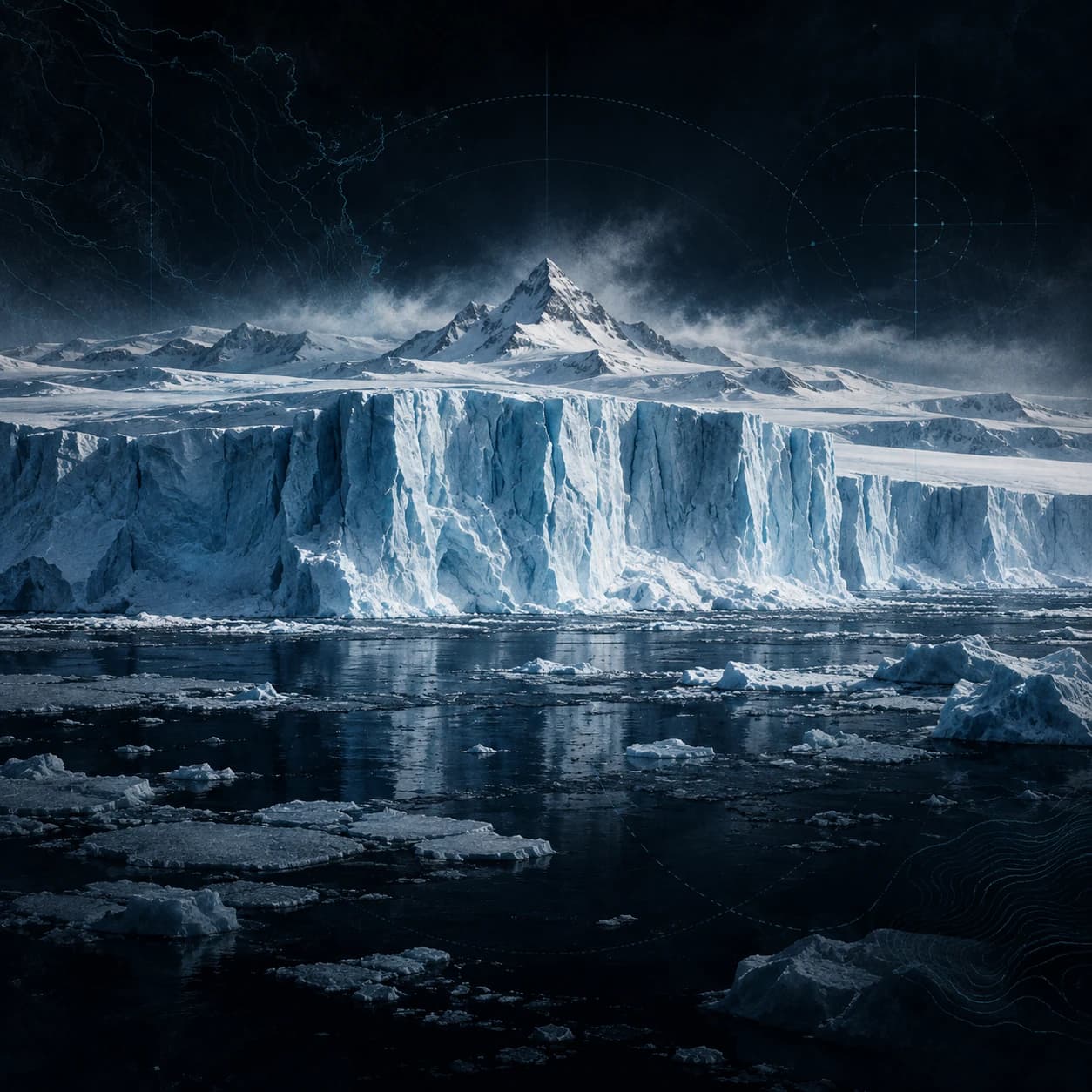
A coastal cliff becomes the world’s retaining wall
The ice-wall claim treats a photograph of a high Antarctic cliff as the edge of an enclosing barrier. The visible wall is real. The inference adds its proposed job: retaining the ocean around a flat world. A useful first test is to establish what supports the photographed kind of ice front.
A floating shelf presents an especially striking case. Its surface looks like land, its front can look vertical, and the observer sees only the portion above the water. That combination conceals most of the structure while making the visible part appear self-supporting.
The ocean is supporting the cliff
The Australian Antarctic Division describes ice-shelf fronts reaching as much as 50 metres above sea level, with much more ice extending below. Shelves are the seaward continuation of ice flowing from the continent. They gain ice upstream and lose it through melting and the calving of icebergs. The front is a changing boundary within that flow.
The supporting mechanism is buoyancy. A floating column displaces seawater with the same weight as the column itself. Dense glacier ice is lighter than seawater, so a small part stands above the surface. A published Getz Ice Shelf study used densities of 917 kilograms per cubic metre for ice and 1,028 for seawater when estimating the submerged ice geometry.
The upper shelf is not all dense ice. Snow gradually compacts into firn, which retains air spaces. That extra volume increases surface height without adding the weight of solid ice. The Getz study therefore corrected its measured surface elevations for modelled firn air content before applying hydrostatic balance. A high surface can reflect both substantial ice and a porous upper layer.
Turn freeboard into a complete floating column
Freeboard is the top surface’s height above local sea level. Start with 50 metres, the cliff scale described by the Antarctic Division, and assume 10 metres of firn air equivalent. The latter is the air volume per unit surface area expressed as a thickness. It is not a ten-metre empty cavity or a measurement of this particular shelf.
Let total thickness be H and air equivalent be A. The amount of solid ice per unit area is equivalent to H minus A, while submerged draft is H minus the freeboard F. Balancing their masses gives 917(H−A) = 1,028(H−F). Solving for H gives total thickness equal to (1,028F−917A)/111.
At the opening settings, the column is about 380 metres thick and extends about 330 metres below the water. Treating it entirely as dense ice gives about 463 metres instead. Each extra metre of freeboard adds roughly 9.3 metres to inferred thickness; each extra metre of air equivalent removes roughly 8.3 metres. The controls make that distinction visible.
This balance applies to freely floating ice. Grounded ice transfers some weight to rock, and the transition near a grounding line can also support bending stresses. A cliff measurement must therefore be paired with knowledge of whether the ice is afloat before it is used as a thickness estimate.
Recover the submerged ice from the visible cliff
For freely floating ice, choose the freeboard and an assumed firn air equivalent. The latter accounts for air spaces distributed through snow and firn.
Subtract the visible freeboard from total thickness to recover the submerged draft.
The full physical thickness, including the distributed air spaces in the porous upper layer.
The comparison shows how ignoring firn air changes a freeboard-derived estimate.
Working tape
- Seawater density minus ice density
1,028 − 917 = 111 - Seawater density times freeboard
1,028 × 50 = 51,400 - Ice density times firn air equivalent
917 × 10 = 9,170 - Freeboard term after the air correction
51,400 − 9,170 = 42,230 - Total floating thickness
42,230 ÷ 111 = 380.45045 - Thickness below sea level
380.45045 − 50 = 330.45045 - Thickness if air spaces are ignored
51,400 ÷ 111 = 463.063063
Fifty metres visible, about 330 metres submerged
The opening cliff has about 380 metres of total thickness, including a draft of roughly 330 metres. Most of its mass is below the observer’s view, displacing the seawater that supports it. The porous surface layer explains why freeboard alone cannot be multiplied by one universal iceberg ratio.
A shelf front is the exposed edge of moving coastal ice. Its vertical face, submerged base and connection to landward glaciers fit together as one physical structure. The ocean is carrying that structure, while calving continually redraws the place where its visible cliff ends.