
Flat Earth Science.
Measure the question.
Compare horizons, shadows, maps and rotation with calculations you can change. Follow the claim into its predicted measurements.
Calculate curvature →- Geometric tangent drop
- 31.39 m
- Hidden target height
- 17.54 m
Two different measurements. Raise the observer to change the hidden height; tangent drop stays tied to the distance and physical radius.
Follow the geometry →Follow the shortest surface route
Choose two coordinate pairs, see departure and arrival bearings, and compare the same route on three maps.
Calculate a route →Departure bearing 148.1° · arrival bearing 150.0°.
Find the Sun and its shadow
Set a UTC instant and place to find solar altitude, compass direction and a level-ground shadow.
Find solar position →A 1 m upright casts a 1.26 m shadow at bearing 357.6°.
Flat Earth
Does the horizon hide a curve?
Start with the horizon. Follow maps, shadows and rotation through 5 investigations with calculations you can change yourself.
Explore Flat Earth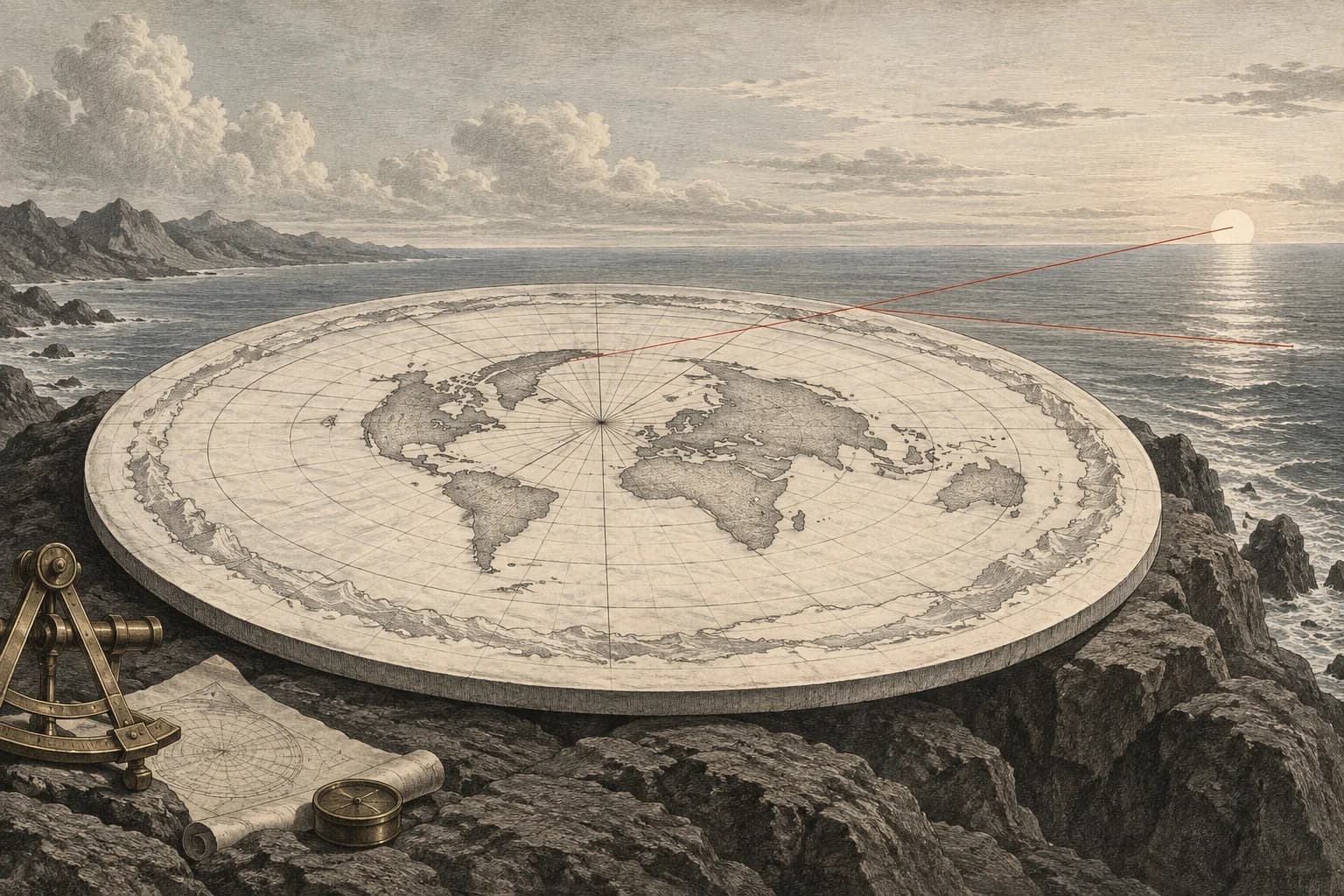 HORIZON / MAPS / SHADOWS
More ways to compare
Choose a shadow, rotation, sky or camera calculation with its own inputs and result.
Earth radius from horizon dip
Infer Earth’s spherical radius from eye height and geometric horizon dip. Compare independent height and angle measurement uncertainty.
Eratosthenes shadow calculator
Estimate Earth’s circumference from two signed noon shadow angles and surface distance. Calculate the radius and measurement uncertainty.
Earth rotation speed calculator
Calculate Earth’s tangential rotation speed at any latitude. Compare the equator, poles, latitude-circle radius and inward acceleration.
Foucault pendulum calculator
Find a Foucault pendulum’s ideal precession rate, full-turn period and direction from latitude, including equatorial and polar limits.
Coriolis path calculator
Plot eastward motion under the horizontal Coriolis term at a fixed latitude. Compare displacement, direction and hemispheric deflection.
Angular size calculator
Calculate a sphere or face-on disk’s angular diameter from size and centre distance. Compare degrees, arcminutes and the small-angle result.
Star trail rotation calculator
Plot a star trail for latitude, declination, starting hour angle and exposure time. Compare sky rotation and the visible above-horizon path.
Polaris altitude and latitude
Compare latitude with the north celestial pole and Polaris’s culmination altitude range. Set declination and altitude-reading uncertainty.
Day length calculator
Compare day length and UTC sunrise and sunset at two latitudes. Includes the same-date seasonal contrast, polar night and midnight Sun.
Map projection distortion calculator
Compare local length and area distortion on Mercator, cylindrical equal-area and north-polar azimuthal equidistant maps at any latitude.
Horizon and lens projection
Compare the same horizon through rectilinear, equidistant and equisolid camera projections. Change pitch, field of view and horizon dip.
Atmospheric refraction ray calculator
Compare a two-layer refractivity profile with straight and constant-gradient rays over a curved surface. Set eye height, launch angle and range.
Three-site shadow model comparison
Fit three signed noon shadow angles to a sphere and a shared local-Sun model. Compare circumference, Sun height and angular residuals.
Local Sun and globe sky comparison
Compare an adjustable nearby Sun and spotlight with astronomical solar directions at three sites at one UTC instant.
Solar eclipse contact comparison
Compare local solar eclipse contact times, central-phase duration, Sun altitude and obscuration at two places, with the 2024 Texas path example.
Understand the geometry and physics
All explanations →Make an observation
Choose an observation →Explore more
8 more ways to follow the evidence.
Take the iceberg route.
Start at the surface. Follow the claims into the details.


How long can a secret hold?
People involved. Years elapsed. Run the model.
Under these assumptions, at least one disclosure is more likely than complete silence.
(1 − 0.001) ^ (100 × 10)= 36.7695% remain silent